Artificial intelligence is becoming a part of our everyday lives. We use AI to write content, answer questions, create images, analyze information, and complete many other tasks.
But a new type of AI is becoming increasingly popular: AI agents.
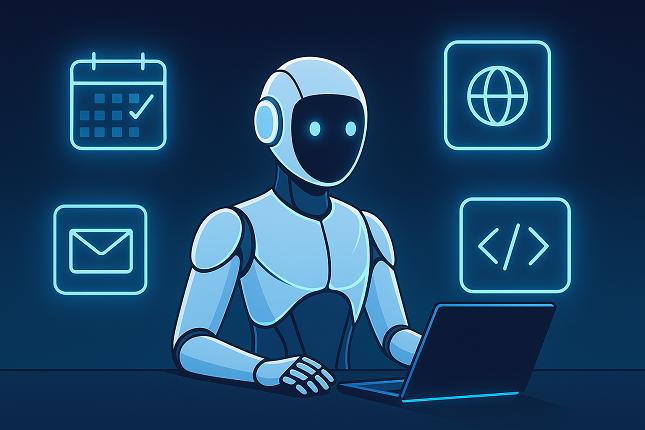
Unlike traditional AI tools that mainly respond to our instructions, AI agents can understand a goal, make decisions, use tools, and complete tasks with less human involvement.
So, what exactly is an AI agent? Let’s understand it in simple words.
What Is an AI Agent?
An AI agent is a software system that can understand a goal, decide what needs to be done, and take actions to achieve that goal.
For example, imagine you tell an AI agent:
“Find three affordable hotels in Delhi for this weekend and create a comparison.”
A normal AI chatbot might give you suggestions based on the information it has.
An AI agent could potentially:
- Search for available hotels.
- Compare prices and ratings.
- Check important details.
- Organize the information.
- Create a comparison for you.
The key difference is that an AI agent is designed to take action, not just provide an answer.
How Does an AI Agent Work?
AI agents generally follow a simple process:
Understand → Plan → Act → Check → Complete
1. Understand the Goal
First, the AI agent understands what you want.
For example:
“Create a weekly social media content plan for my business.”
The agent identifies the objective and requirements.
2. Make a Plan
The agent decides what steps are needed to complete the task.
It may decide to research the audience, identify topics, create content ideas, and organize them into a calendar.
3. Take Action
The agent can use different tools to perform tasks.
Depending on how it is built, an AI agent may be able to interact with websites, databases, APIs, software applications, or other digital tools.
4. Check the Results
Some AI agents can review their work and determine whether the result meets the goal.
If something is missing, the agent may take another step to improve the result.
5. Complete the Task
Finally, the agent provides the finished result to the user.
This makes AI agents useful for tasks that involve multiple steps.
AI Chatbot vs AI Agent
AI chatbots and AI agents are related, but they are not exactly the same.
A chatbot is usually focused on conversation. You ask a question, and it provides an answer.
An AI agent can go further. It can use information and tools to perform actions toward a specific goal.
For example:
Chatbot:
“Here are some ideas for a marketing campaign.”
AI Agent:
“Here is the marketing campaign I created based on your requirements.”
The exact capabilities depend on the particular AI system, but the general idea is that agents are designed to be more action-oriented.
Examples of AI Agents
AI agents can be used in many areas.
Customer Service
AI agents can answer customer questions, find information, and help resolve common issues.
Marketing
Marketing agents can help with research, content planning, campaign analysis, and reporting.
Sales
Sales agents can help identify potential customers, organize information, and assist with follow-ups.
Software Development
AI coding agents can help developers write code, find bugs, test software, and work through development tasks.
Personal Productivity
An AI agent could help organize tasks, summarize information, prepare documents, or manage repetitive digital work.
Research
AI agents can help collect information from different sources, analyze it, and organize the findings.
What Makes AI Agents Different?
The biggest difference is autonomy.
Traditional software usually follows fixed instructions.
AI agents can use AI models to understand goals and determine the next steps.
For example, if you ask an agent to research a topic, it may decide what information it needs, search for relevant sources, analyze the information, and prepare a result.
However, not every AI agent is fully autonomous. Some require human approval before taking important actions.
Benefits of AI Agents
AI agents can provide several benefits:
- Save time: They can handle repetitive tasks.
- Automate workflows: Multiple steps can be connected together.
- Improve productivity: People can focus on more important work.
- Work continuously: Some agents can operate without constant human involvement.
- Handle complex tasks: They can break larger goals into smaller steps.
Are AI Agents Perfect?
No. AI agents can make mistakes.
They may misunderstand instructions, use incorrect information, or take an inappropriate action. This is why human supervision can still be important, especially for tasks involving money, personal information, business decisions, or other important consequences.
The quality of an AI agent also depends on the AI model, tools, data, and instructions behind it.
The Future of AI Agents
AI agents are becoming an important part of the future of artificial intelligence.
Instead of simply asking AI questions, people may increasingly give AI goals and let it handle multiple steps to achieve them.
For businesses, this could mean automating repetitive workflows. For individuals, it could mean having AI assistants that help manage everyday digital tasks.
As the technology improves, AI agents may become easier to use and more capable.
Final Thoughts
An AI agent is an AI-powered system that can understand a goal, plan steps, use tools, and take actions to complete a task.
The simplest way to think about it is:
A chatbot mainly talks with you. An AI agent can work for you.
AI agents are still developing, but they have the potential to change how people work with technology. Understanding them today can help you prepare for the next stage of AI.