 Artificial intelligence (AI) is becoming a part of our everyday lives. From chatbots and virtual assistants to writing tools and translation apps, many AI systems use language models to understand and work with human language.
But what exactly is a language model?
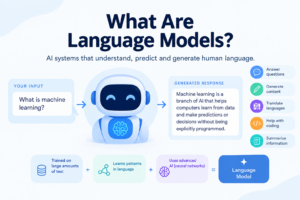
In simple terms, a language model is an AI system that learns how language works and uses that knowledge to understand, predict, and generate text.
When you ask an AI chatbot a question and it gives you an answer that sounds natural, a language model is usually working behind the scenes.
What Is a Language Model?
A language model is a type of artificial intelligence trained to work with text and language.
It learns patterns from large amounts of text, such as books, websites, articles, and other written material. During training, the model learns how words and sentences are commonly used together.
For example, if you write:
“The sun rises in the…”
A language model can predict that the next word is likely to be “east.”
It does this by recognizing patterns it learned during training.
Modern language models can do much more than predict the next word. They can answer questions, summarize information, translate languages, write content, explain concepts, and help with many other tasks.
How Do Language Models Work?
Language models are trained using huge amounts of text.
During training, the model looks at text and learns relationships between words, phrases, and sentences. It doesn’t simply memorize every sentence. Instead, it learns patterns that help it make predictions.
For example, consider these sentences:
- “I drink coffee in the morning.”
- “I drink tea in the morning.”
- “I drink water after exercising.”
From examples like these, the model learns how words are related and how sentences are structured.
When you give the model a new sentence or question, it uses the patterns it learned to generate a response.
Modern language models use advanced AI techniques, particularly neural networks, to process and understand large amounts of information.
What Is a Large Language Model (LLM)?
You may have heard the term Large Language Model, or LLM.
An LLM is simply a language model that has been trained using a very large amount of data and has a large number of parameters.
Parameters are values that the model learns during training. They help the model recognize patterns and relationships in language.
Popular AI systems such as ChatGPT, Google Gemini, and Claude use large language models to generate and understand text.
Because these models are trained on large datasets and have many parameters, they can perform a wide variety of language-related tasks.
What Can Language Models Do?
Language models can be used for many different purposes.
1. Answer Questions
You can ask a language model questions about different subjects, and it can generate an answer based on patterns and information learned during training.
For example, you could ask:
“What is machine learning?”
The model can provide a simple explanation.
2. Generate Content
Language models can help create blog posts, emails, social media captions, product descriptions, and other types of content.
They can also adjust the writing style based on your instructions.
3. Summarize Information
If you have a long piece of text, a language model can summarize the main points and make the information easier to understand.
4. Translate Languages
Language models can help translate text between different languages. They can also help explain words and phrases in context.
5. Help With Coding
Many modern language models can understand programming languages and assist developers with writing, explaining, and debugging code.
6. Have Conversations
AI chatbots use language models to have conversations with users. They can understand questions and generate responses that are designed to sound natural.
What Is the Difference Between a Language Model and a Chatbot?
These two terms are often confused.
A language model is the AI technology that processes and generates language.
A chatbot is an application that uses AI technology to communicate with users.
Think of it this way:
Language model = the technology
Chatbot = the application using the technology
For example, a chatbot can use a language model to understand your question and generate a response.
Are Language Models Always Correct?
No.
One important thing to understand is that language models can sometimes provide incorrect or misleading information.
A language model generates responses based on patterns learned during training and the information available to it. It does not automatically know whether every statement it produces is true.
Sometimes, it may confidently provide an incorrect answer. This is often referred to as an AI hallucination.
For important topics such as medical, financial, legal, or current information, it is important to verify AI-generated information using reliable sources.
Why Are Language Models Important?
Language models are changing the way people interact with computers.
In the past, people often needed to use specific commands or software interfaces to complete tasks. Today, language models allow people to communicate with computers using everyday language.
You can simply type what you need, and the AI can try to understand your request.
This makes technology easier to use for many people and has created new possibilities in education, business, marketing, software development, customer service, and many other areas.
The Future of Language Models
Language models are continuing to improve.
Future models are expected to become better at understanding context, following instructions, working with different types of information, and completing more complex tasks.
They are also becoming an important part of AI agents, productivity tools, search systems, and business applications.
As these technologies develop, understanding the basics of language models can help you better understand how modern AI works.
Conclusion
A language model is an AI system that learns patterns in human language and uses those patterns to understand and generate text.
From answering questions and writing content to translating languages and helping with code, language models have many practical applications.
Large Language Models, or LLMs, have made this technology much more powerful and accessible. Tools such as ChatGPT, Gemini, and Claude show how language models can be used in everyday life.
You don’t need to be a technical expert to understand language models. Learning the basic idea—that these systems learn patterns in language and use them to generate responses—is a great first step toward understanding modern artificial intelligence.